
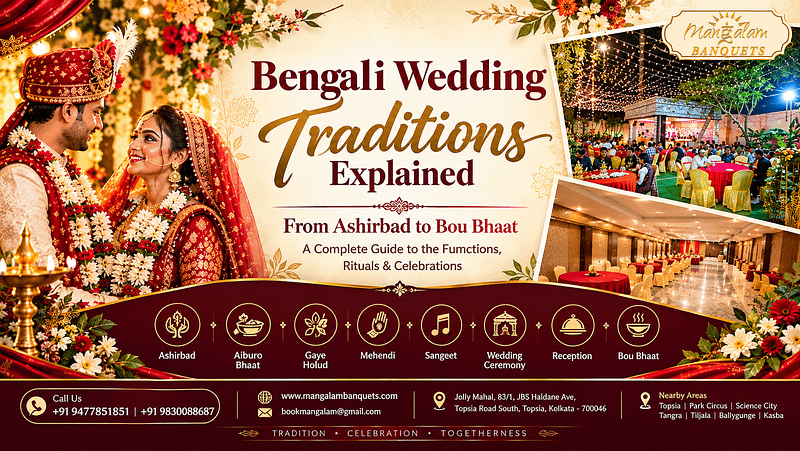
Bengali weddings are known for their rituals, family gatherings, traditional food, beautiful attire and celebrations that often continue across several functions. While every family may follow its own customs, a traditional Bengali wedding usually includes several important moments before, during and after the main ceremony.
For couples planning a wedding in Kolkata, understanding these traditions can make it easier to decide which functions to host, how to structure the celebration and how to create a comfortable experience for family and guests.
This guide explains some of the most commonly recognised Bengali wedding traditions, while also looking at how families are adapting them for modern celebrations.
What Makes a Bengali Wedding Special?
A Bengali wedding is not usually just one event.
It can be a series of celebrations involving both families, close relatives and friends.
Depending on the family, a wedding may include:
- Ashirbad
- Aiburo Bhaat
- Gaye Holud
- Mehendi
- Sangeet
- Wedding ceremony
- Reception
- Bou Bhaat
Not every family follows every tradition, and the order can vary.
Modern couples may also combine traditional customs with contemporary décor, photography, music and event formats.
The result is often a celebration that feels both traditional and personal.
1. Ashirbad – The Blessing Before the Wedding
Ashirbad is traditionally associated with the formal blessing of the bride and groom by elders of the family.
It can take place before the wedding and may involve the two families coming together for a relatively intimate celebration.
Elders may bless the couple and offer traditional gifts or symbolic items.
For many families, Ashirbad is less about a large ceremony and more about marking the beginning of the wedding journey.
Today, some families keep it simple at home, while others organise a separate gathering with close relatives.
2. Aiburo Bhaat – A Special Meal Before Marriage
Aiburo Bhaat is a Bengali pre-wedding tradition associated with enjoying a special meal before marriage.
The expression is commonly connected with a person’s final traditional meal as an unmarried individual.
Food plays an important role in this tradition.
Depending on the family, the meal may include favourite Bengali dishes and sweets.
Modern families may celebrate Aiburo Bhaat at home, at a restaurant or as part of a larger pre-wedding gathering.
It is also a wonderful example of how Bengali weddings connect food, family and tradition.
3. Gaye Holud – The Traditional Turmeric Celebration
One of the most recognisable Bengali pre-wedding functions is Gaye Holud.
It is traditionally associated with applying turmeric to the bride and groom before the wedding.
The function is often colourful, informal and full of family participation.
Modern Gaye Holud celebrations can include:
- Floral décor
- Yellow-themed decoration
- Music
- Dancing
- Photography
- Family performances
- Mehendi
- Traditional Bengali food
- Couple portraits
For larger families, Gaye Holud can also become a proper event rather than a small household ritual.
4. Mehendi – A Popular Modern Addition
Mehendi has become an increasingly common part of Indian weddings, including Bengali celebrations.
Although Mehendi is not necessarily a traditional Bengali wedding ritual in the same way as some older customs, many modern Bengali weddings now include it as a separate pre-wedding activity.
It can be combined with:
- Gaye Holud
- Sangeet
- Ladies’ gatherings
- Family celebrations
This is a good example of how wedding traditions evolve.
Families can preserve their Bengali customs while incorporating newer elements that make sense for the couple and their guests.
5. Sangeet and Family Performances
Sangeet-style celebrations have also become popular among modern Bengali wedding families.
The focus is usually on music, dance and performances by friends and relatives.
A Sangeet evening may include:
- Couple performances
- Family dance performances
- Friends’ performances
- Music
- DJ
- Couple entry
- Stage activities
- Photography and videography
Unlike the more formal wedding ceremony, Sangeet usually provides an opportunity for everyone to relax and participate.
6. The Bengali Wedding Ceremony
The main wedding ceremony is where many of the most recognisable Bengali wedding traditions take place.
The exact rituals vary between families and communities, but several familiar elements are often associated with a traditional Bengali Hindu wedding.
The ceremony may involve:
- Bride and groom’s entrance
- Shubho Drishti
- Mala Badal
- Saat Paak
- Wedding rituals around the sacred fire
- Sindoor Daan
- Blessings from elders
The ceremony is usually the emotional centre of the wedding.
This is also the part of the celebration where timing and event coordination become particularly important.
Guests may need to move between seating areas, the ceremony space, dining area and photography locations.
7. Shubho Drishti
Shubho Drishti is one of the most recognisable moments in a traditional Bengali wedding.
It refers to the auspicious first sight between the bride and groom.
The moment is often accompanied by excitement from family and guests.
Because it is such an important photographic moment, families and photographers often plan carefully around the ceremony setup.
Good lighting and an uncluttered ceremony area can make a significant difference to photographs.
8. Mala Badal – Exchange of Garlands
Mala Badal refers to the exchange of floral garlands between the bride and groom.
In many Bengali weddings, this can become one of the most energetic moments of the ceremony.
Family members and friends often participate enthusiastically, making it a memorable part of the celebration.
From a photography perspective, it is also one of the moments where candid reactions from family members can make excellent wedding photographs.
9. Saat Paak
Another well-known Bengali wedding tradition is Saat Paak, associated with the bride and groom completing traditional ceremonial rounds.
The exact form and details can vary depending on family traditions and community practices.
Because the ceremony involves specific movements and rituals, the mandap or wedding area needs enough room for the couple, priests and immediate family members.
This is one reason why event layout matters just as much as decoration.
10. Sindoor Daan
Sindoor Daan is traditionally associated with the groom applying sindoor to the bride as part of the Bengali Hindu wedding ceremony.
It is an important symbolic moment and is often followed by blessings and photographs with close family members.
Families may choose to keep the ceremony traditional while designing the surrounding event space in a contemporary style.
11. The Role of Food in a Bengali Wedding
It is almost impossible to discuss a Bengali wedding without discussing food.
Food is deeply connected to Bengali celebrations.
Depending on the family and event, wedding menus may include dishes such as:
- Shukto
- Dal
- Fried vegetables
- Fish preparations
- Chicken or mutton
- Rice or pulao
- Chutney
- Papad
- Mishti
- Payesh
The actual menu varies considerably from family to family.
Some families prefer a highly traditional Bengali menu, while others combine Bengali favourites with North Indian, Chinese or other cuisines.
The important thing is to plan the menu around the guests and the type of celebration.
12. Bou Bhaat – The Celebration After the Wedding
Bou Bhaat is traditionally associated with the bride’s first meal or reception-related celebration after marriage, particularly in Bengali Hindu families.
Like many wedding customs, its form can vary between families.
For some families, Bou Bhaat remains a traditional family occasion.
For others, it has evolved into a larger reception-style celebration involving relatives, friends, food and photography.
Modern couples may combine traditional elements with contemporary reception arrangements.
13. Bengali Wedding Reception
The reception is often the most flexible part of the wedding celebration.
Unlike the main ceremony, the reception can be designed around the couple’s preferred style.
Families may include:
- Stage décor
- Couple seating
- Guest photography
- Buffet
- Music
- Family introductions
- Speeches
- Entertainment
- Formal photographs
For a large guest list, planning the flow between arrival, photography, seating and dining becomes particularly important.
14. How Modern Bengali Weddings Are Changing
Bengali weddings are evolving.
Many couples still want traditional rituals, but they also want the wedding to reflect their personalities.
That can mean combining:
Traditional rituals + modern décor + contemporary photography + personalised entertainment
For example, a traditional Gaye Holud might have modern floral décor.
A traditional wedding ceremony might be followed by a contemporary reception.
A Bengali menu might be combined with live food counters or other cuisines.
This flexibility is one of the reasons Bengali weddings can feel different from one family to another.
15. Hosting Multiple Bengali Wedding Functions
If a family is organising several functions, one important decision is whether to use different locations or plan multiple celebrations around the same venue.
Using a suitable event venue for several functions can simplify:
- Guest communication
- Travel arrangements
- Vendor coordination
- Photography planning
- Family logistics
- Decoration planning
- Event scheduling
However, each function should still have its own identity.
For example:
Gaye Holud
Bright, colourful and informal.
Sangeet
Music-focused and energetic.
Wedding
Traditional and ceremonial.
Reception
Elegant and formal.
The same venue does not have to make every event look the same.
16. Planning the Wedding Around Your Guests
Traditional ceremonies are important, but guests should also be considered.
Think about:
- Elderly relatives
- Children
- Guests travelling from outside Kolkata
- Seating
- Dining
- Parking
- Washrooms
- Waiting areas
- Ceremony duration
- Weather
A wedding can look beautiful while still becoming uncomfortable if guests have nowhere convenient to sit, eat or move around.
Good planning balances tradition with hospitality.
17. Choosing the Right Event Setup for a Bengali Wedding
Different functions may require different types of spaces.
A smaller family gathering may work well in an intimate event space.
A larger reception may require a larger banquet setup.
An outdoor function may benefit from an open lawn, while a summer or weather-sensitive ceremony may be more comfortable indoors.
Mangalam Banquets in Topsia offers a fully air-conditioned banquet hall, open-air lawn and mini space, giving families different options depending on the size and nature of their celebration.
The current website lists approximately 300 guests for the AC banquet hall, 300 for the open-air lawn and 60 for the mini space, with larger floating-event flexibility across the available spaces.
18. A Simple Bengali Wedding Planning Checklist
Before finalising your wedding arrangements, discuss:
Pre-Wedding Functions
☐ Ashirbad
☐ Aiburo Bhaat
☐ Gaye Holud
☐ Mehendi
☐ Sangeet
Main Wedding
☐ Ceremony setup
☐ Mandap
☐ Seating
☐ Photography
☐ Guest movement
☐ Food arrangements
Reception
☐ Stage
☐ Couple seating
☐ Guest reception
☐ Photography
☐ Dining
☐ Entertainment
Guest Experience
☐ Elderly guests
☐ Children
☐ Parking
☐ Washrooms
☐ Seating
☐ Guest directions
☐ Weather considerations
Bengali Weddings Are About More Than Rituals
The beauty of a Bengali wedding is not simply in the number of rituals.
It is in the way families come together.
It is in the food prepared for guests, the excitement of relatives, the music, the laughter, the traditional attire, the photographs and the small moments that families remember years later.
Some families may follow almost every traditional custom.
Others may select only a few important rituals.
There is no single format that defines every Bengali wedding.
The best celebration is one that respects the family’s traditions while creating an experience that feels comfortable, meaningful and personal.
Planning a Bengali Wedding in Kolkata?
For families planning Bengali wedding functions in Kolkata, Mangalam Banquets offers multiple event spaces that can be arranged according to the nature of the celebration.
From pre-wedding gatherings and Haldi functions to the main wedding and reception, families can discuss their event requirements, guest count, catering, decoration and preferred setup with the venue team.
Located at Jolly Mahal, Topsia Road South, 83/1, JBS Haldane Avenue, Topsia, Kolkata, Mangalam Banquets is also conveniently positioned for families coming from areas around Topsia, Park Circus, Science City, Tangra, Tiljala, Ballygunge and Kasba.
📞 +91 9477851851 | +91 9830088687
📧 bookmangalam@gmail.com
🌐 www.mangalambanquets.com
Final Thoughts
A Bengali wedding can be traditional, modern, intimate, grand or a combination of all four.
The rituals may differ from family to family, but the central idea remains the same: bringing two families together to celebrate a new chapter.
Whether it is Ashirbad, Gaye Holud, the wedding ceremony, reception or Bou Bhaat, each function can have its own character while still forming part of one memorable wedding journey.
And that is what makes Bengali weddings in Kolkata so special — tradition continues, but every generation finds its own way to celebrate it.